Showing posts with label architecture. Show all posts

Monday, 17 August 2015

SPELLBINDING FORT AGUADA
HISTORY AND DESIGN


The history of Goa is intrinsically linked to the many centuries of Portuguese presence and rule. Before the arrival of the Portuguese most Goan homes were made of mud and had thatched roofs with a central courtyard.


In 1510 the Portuguese arrived in Goa and brought with them both cultural and aesthetic sense from Europe. This mixed with the newly converted Christians who incorporated many aspects of their Goan cultural roots resulted in a unique fusion, which was also reflected in the design of their homes.
Besides the bungalow type mansions with their wrought iron balconies and pillared porches, the Portuguese also dotted the coast with several forts.


THE FORT AGUADA 


The fort was the most prized and crucial fortS of the Portuguese due to its strategic location.
 Built in 1613 to guard against the Dutch and the Maratha warriors, was built on the beach south of Candolim.
A freshwater spring within the fort provided water to ships stopping by, this is how the fort got its name, "Aguada" means water.


Designed and brilliantly planned by the Italian military architects employed by the Portuguese Government in Lisbon and constructed during the reign of King Dom Filippe of Portugal.

On the fort stands a four-storey high light house( 43 feet tall), erected in 1864 , it was the grandstand for 79 cannons, and could hold 2,376,000 gallons of water. The walls are 16 feet high and 4 feet thick and it has a wide dry moat surrounding it.


The fort is divided into two segments: the upper part served as the lighthouse and watering station, while the lower part served as a safe berth for Portuguese ships.


Now the lower part of the fort is the central jail of Goa and is used to imprison convicts connected with narcotics. Most of the fort is now inaccessible but still worth a visit on your next trip to Goa.

Thursday, 13 August 2015

WATSONS HOTEL
SHADES OF OBLIVION 


I bet most of you don't even know where this is in Mumbai?


119 years ago an audience of European paid a Rupee each to watch a show which has been billed as "The Marvel of the century". That rainy Tuesday in July 1896 , motion pictures debuted in India, at Watson's Hotel in then what was called Bombay.


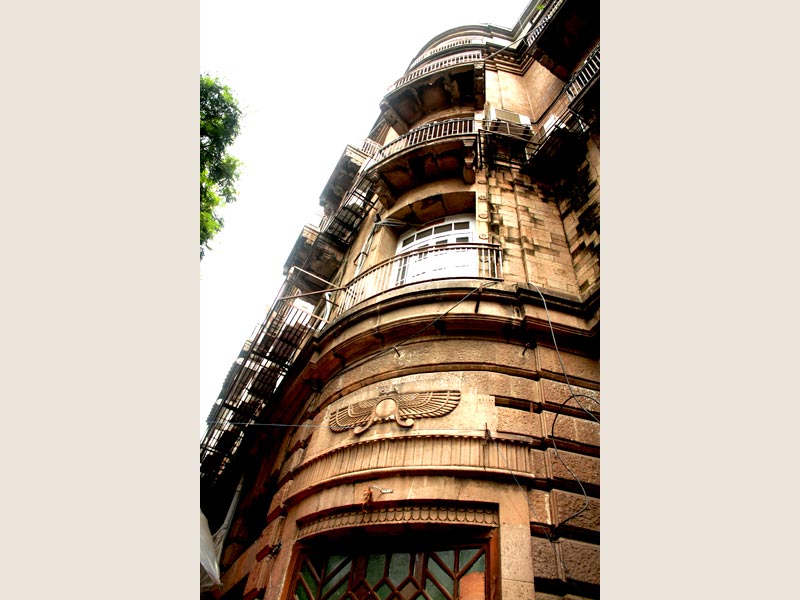
Watson's Hotel at one time, the swankiest hotel in town is located in South Mumbai and is now called Esplanade Mansion. It's story dates back to the mid 19th century when the city was beginning to prosper, thanks to a booming cotton trade. The hotel threw its doors open to "European only" clientele in 1871.

The hotel had 131 rooms, its cast iron structure was fabricated in England and then put together in Bombay. On Monday nights they hosted a ball, a very sought after social gathering of Europeans, an excellent band was engaged and the dancing went on till the wee hours of the morning.

MONOGRAM "W" ON THE BALCONY RAILING

As the hotels reputation spread visiting dignitaries only stayed at Watson's. Like all hotels Watsons also witnessed suicides, drunken guests who fell off balconies and midnight brawls.

As Bombay continued to grow, trams came in in 1874 and electricity in 1882.
In 1882 Watsons went in for a major face lift, adding a hydraulic lift and a bar.

Mark Twain stayed in the hotel in 1896, in a chapter of his book Following the Equator, he describes his visit as follows" The lobbies and halls were full of turbaned, and fez'd and embroidered cap"d and barefoot, and cotton-clad dark natives........in the dining room every man's own private native servant standing behind his chair, and dressed for a part in Arabian Nights."


The hotels decline was gradual but stark. The death of the Founder, J H Watson, followed by the subsequent sale and new competition.

The Taj Mahal opened with 400 rooms in 1903 with attractions like electric lifts, lights, bars, smoking rooms and a hotel orchestra. A popular myth is that J N Tata built the Taj Mahal after he was denied entry into Watsons.


SMOKING ROOM TAJ MAHAL HOTEL

In 1960 Watsons closed down. Today all that is left of this majestic hotel is its magnificent iron pillars and wooden staircase. The place has been divided into small rooms which have been rented out to tailors, photo copy shops and lawyers.

                                                  THEN


VERANDAH OF WATSONS HOTEL,1870

                                                  
                                               NOW


 MUMBAI'S ART DECO MASTERPIECES


Art deco has become such an integral part of the Mumbai landscape, it sometimes seems like it was born in the city. Did you know that Mumbai has the second largest number of surviving art deco buildings in the world, after Miami?

Art deco’s came to Mumbai at a time when the city was flourishing and construction activity and reclamation was at its peak. In the 1930s, as land reclamation and suburbanization schemes in the Dadar-Matunga area gave Mumbai ample room to grow, the city’s first generation of architects trained in the West were returning home. On these plots, they created a variety of art deco masterpieces, both public and private, some grandiose, others rather more functional. 


In true Indian style, Art Deco in Bombay evolved into a unique style incorporating elements of Hindu architecture. Deco details touched every architectural aspect - lamps, flooring, wood panelling, mouldings, cornices, verandahs, etched glass etc . This style was called "Bombay Deco"


In Mumbai architects used different materials to express their design, for instance many buildings were constructed entirely out of RCC but had a cladding facade of Malad stone.

Like most mature styles, Art Deco too lent itself to buildings as diverse as the charming residence of Sans Soucci on Malabar Hill to the imposing Reserve Bank building on Mint road.
Post independence the Art deco style gradually dwindled as architects shifted to styles that were more modern and functional and devoid of any ornamentation.

Some of the best examples of Bombay's art deco can be observed along the western side of the Oval Maidan in the Churchgate area. The buildings here, built in the 1930s, have names like Palm Court and Greenfields and Court View. Don’t miss the panels of tropical birds at Swastik Court, the clouds, sun and waves on the metal grilles at Empress Court, the Greek frozen fountain motif at the entrance of Court View.


UNDERSTANDING ART DECO

The term Art Deco refers to an architectural style that was popular in the 1920's and 30s, it was considered ultramodern at the height of its popularity. The second world war saw the decline of this style as it seemed to be too gaudy and ostentatious for wartime austerity. 

The Chrysler building and the Empire State building are perhaps the most famous art deco gems.
CHRYSLER BUILDING
EMPIRE STATE BUILDING


KEY ELEMENTS


COURT VIEW STAIRCASE

BUILDING SIGNAGE

ART DECO GATE

LIBERTY CINEMA INTERIOR
  • 1. Flat roofs.
  • 2. Smooth walls. The walls of art deco homes are often made of smooth stucco and have rounded corners.
  • 3. Bold exterior decorations. Buildings in the style were often decorated with zigzags, swans, lilies and sunrise motifs.
  • 4. Experimentation with interior materials. Art deco designers used "new" materials such as glass block, neon, chrome, mirrors and opaque glass panels, inlaid wood
ART DECO NEIGHBORHOODS 
1. FORT
CURIMJI HOUSE


UNITED INDIA BUILDING ON PM ROAD
INDIAN MURAL ON THE WALL OF WESTERN INDIA HOUSE
ROUNDED BALCONIES VATCHA AGIARY
ELEPHANT MOTIFS ON LAKSHMI INSURANCE BUILDING


2. MARINE DRIVE
TARAPOREWALA AQUARIUM
SOONA MAHAL


3. MARINE LINES
LIBERTY CINEMA

4. OVAL AREA AND CHURCHGATE
INDIAN MERCHANTS CHAMBER
ASTORIA HOTEL CHURCHGATE
INDUSTRIAL ASSURANCE BUILDING CHURCHGATE
COURT VIEW 1938
SHIV SHANTI BHAVAN WITH ITS GLASS PANEL AND SUNBURST MOTIF
EROS CINEMA WITH ITS CYLINDRICAL TOWER

RAJJAB MAHAL


5.COLABA AND BALLARD ESTATE
SHELLEYS HOTEL COLABA

DHANRAJ MAHAL
HORNIMAN CIRCLE
REGAL CINEMA
NEW INDIA ASSURANCE BUILDING, BALLARD ESTATE
A CLOSER VIEW